If you’re a trans+ worker reading this and feeling scared about your job, your safety, or your future, please know that you belong in the workplace. You deserve to work with dignity.

You are not a burden or a “third space” person. You are a valuable employee, colleague, and human being. This ruling is unjust, and it will be challenged. At Anne, we stand with you.

What the ruling says about trans+ employees and workplace facilities

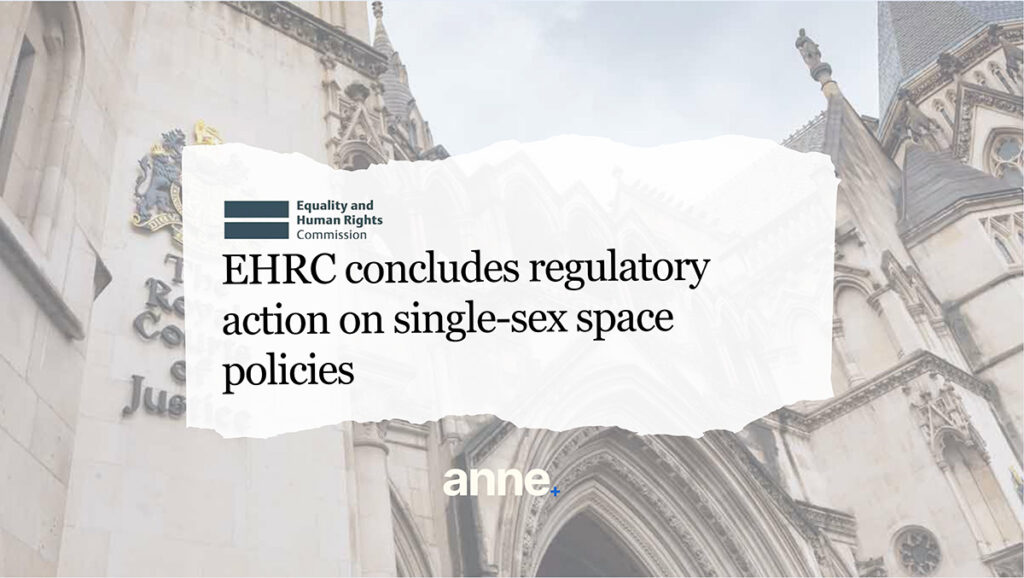
The recent High Court ruling on trans+ rights in the UK has created a troubling double standard. While the court rightly recognised that service providers can include trans+ people in facilities matching their gender, it has put both trans+ employees and many businesses in an impossible position.

The ruling says one thing for customers and another for employees. Shops, gyms and cafes should let trans+ people use facilities aligned with their gender identity. But if you work there? Suddenly, different rules apply. This makes no sense, it creates two different rules for one person. A trans+ person shouldn’t lose their dignity the moment they enter the workplace.

The court suggests that making trans+ employees use separate “gender neutral” facilities will “rarely” be discriminatory. It ignores the reality of violence and discrimination that trans+ people face every day and reduces the higher rates of workplace harassment and discrimination experienced by trans+ workers to “workplace gossip”, dismissed as something “anyone can be expected to bear.”

How the ruling undermines workplace privacy, dignity and equal treatment

We believe this ruling causes harm for several reasons.

Firstly, it outs people. Imagine you’ve used the women’s toilet inside and outside your office for years. Suddenly you’re told to use the gender neutral toilet on another floor at work. Your colleagues will notice and as a result they’ll ask questions. Privacy is a human right and something everyone deserves at work. Under this ruling, that vanishes.

Secondly, it’s humiliating. Being singled out and sent elsewhere marks trans+ employees as different, as a problem to be managed rather than people to be included. No one should have to experience that at their workplace.

Thirdly, it treats trans+ people as a third class of person. While cisgender colleagues use ordinary facilities, trans+ employees are singled out and segregated. The European Convention on Human Rights (ECHR) protects everyone’s dignity and privacy. This ruling undermines those protections.
The court’s reasoning about privacy is inconsistent.

Why trans+ employees’ privacy rights do not disappear at work

If trans+ people are allowed to use public facilities aligned with their gender without issue, why does this differ in the workplace? Your rights shouldn’t suddenly disappear because you’re an employee. This inconsistency isn’t just confusing, it’s discriminatory. It treats trans+ workers as less deserving of dignity than trans+ customers.

Trans women have been using women’s facilities for decades without incident. Privacy is important for everyone, including trans+ people. But privacy isn’t violated by someone using a toilet stall with a locked door. The court recognised this for trans+ service users. The same logic must apply to trans+ workers.

This is about more than just women’s bathrooms

While the High Court ruling affects all trans+ people, the legal battle has focused almost exclusively on transgender women and women’s bathrooms. Transgender men, non-binary and intersex people face many of the same challenges, yet remain almost invisible from the conversation.

The question should be, how do we create workplaces where all trans+ people can work safely? Instead, rhetoric consistently centres on whether trans women should be excluded from women’s spaces. This narrow focus exposes the real agenda, which isn’t actually about protecting safety or privacy, but specifically targeting and excluding trans women.

What about the UK’s estimated 358,000 to over 1 million intersex people, those whose biological sex characteristics don’t fit neatly into male or female categories? Which facilities should they use? Are they too expected to disclose?

This ruling, and workplace bathroom policing, affects us all

This ruling also doesn’t just affect trans+ people. It affects everyone. If employers start monitoring and enforcing who uses which toilet, that means policing everyone. Someone at work will need to check, to ask questions and enforce the rules.

Cisgender women who don’t or can’t conform to traditional femininity, women with short hair, tall women, muscular women, masculine women, may find themselves questioned.

Cisgender men who don’t fit masculine stereotypes could face similar scrutiny. This is about scrutiny and control that affects dignity and privacy for all workers. When you create a system that monitors and sorts people by gender, everyone gets caught in that system. Privacy and dignity at work are universal values. Once you start policing bathrooms, no one is exempt from that policing.

The impact on business owners

Beyond the human cost, the practical problems of the High Court’s ruling for businesses are enormous. Many workplaces cannot comply. Small offices, office buildings, workplaces across multiple sites. Many, if not most, do not have the space or resources to provide separate facilities.

Employers would need to provide completely separate facilities for trans+ staff, enforce rules about who uses which toilet and monitor/police their employees’ bathroom use. Who is expected to check which toilet someone uses and who enforces these rules? The High Court ruling creates a surveillance system that no workplace should have.

The court has created an unworkable system that will either be ignored or cause real economic hardship for both trans+ workers and business owners alike. In practice it simply won’t work. It also makes trans+ people unemployable in some settings. If a workplace cannot or will not provide appropriate facilities, trans+ people may be effectively excluded from working there as a result.

A free pass to exclusion

Trans+ people already face higher unemployment rates, workplace discrimination, barriers to career progression and mental health impacts from hostile work environments. This ruling makes all of this worse. It gives a free pass to exclusion by making it harder for trans+ people to find and keep work where their dignity, privacy and respect is upheld.

Why this decision must be challenged to protect trans+ workers

The Good Law Project is appealing this decision, and they are right to do so. Trans+ rights are human rights. The Equality Act 2010 was meant to protect people from discrimination. This ruling has twisted it to do the opposite, forcing employers to single out and exclude trans+ workers. The Minister for Women and Equalities must reject any guidance based on this workplace ruling. Parliament must ensure the law protects all workers equally.

Every worker deserves privacy at work, freedom from humiliation and equal treatment regardless of who they are. Until this ruling is overturned, trans+ workers are left in limbo, welcome as customers, but treated as problems when they’re employees. Not only is this unjust and inconsistent, it’s unworkable and incompatible with basic human rights.

We unequivocally stand with trans+ workers and will continue to provide updates on this unjust ruling. Privacy, dignity, respect and equal access to workplace facilities are not privileges; they are rights.

Useful links

Trans inclusion after the High Court decision on the EHRC’s interim guidance: FAQs (Good Law Project)

Your journey, your pace, your care

Take the first step with Anne.

We’re here to guide and support you with inclusive, gender-affirming care built around you.


Sign up to our mailing list

For all the tea, T and trans+ healthcare updates.


See our privacy policy


* indicates required